21bit Payment Methods Australia: Deposits, AUD and Crypto
 Available in US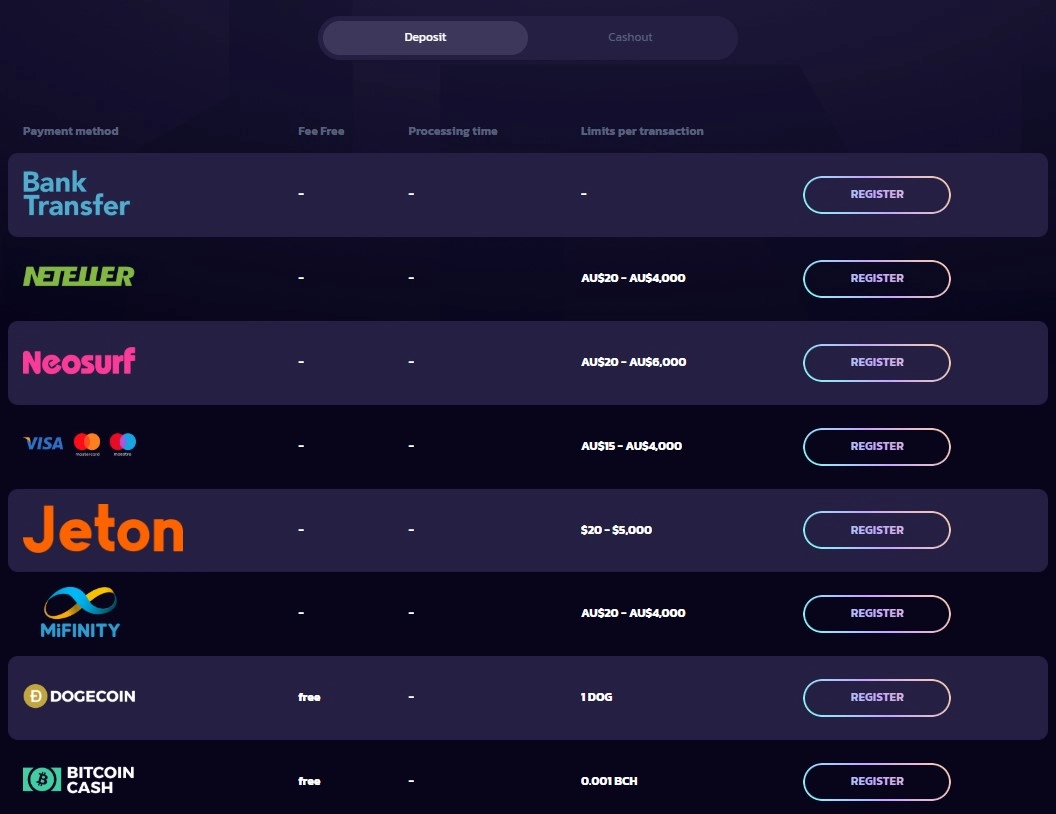
Content
21bit supports AUD and offers payment routes across cards, e-wallets, bank transfers and cryptocurrencies. For an Australian reader, that broad coverage is more useful than a long list of familiar local payment brands, because the current cashier must be checked before assuming that a specific method is available to a particular account. PayID, Apple Pay and Google Pay are familiar names in Australia, but they are not treated as 21bit-supported methods here unless they are visible in the live cashier.
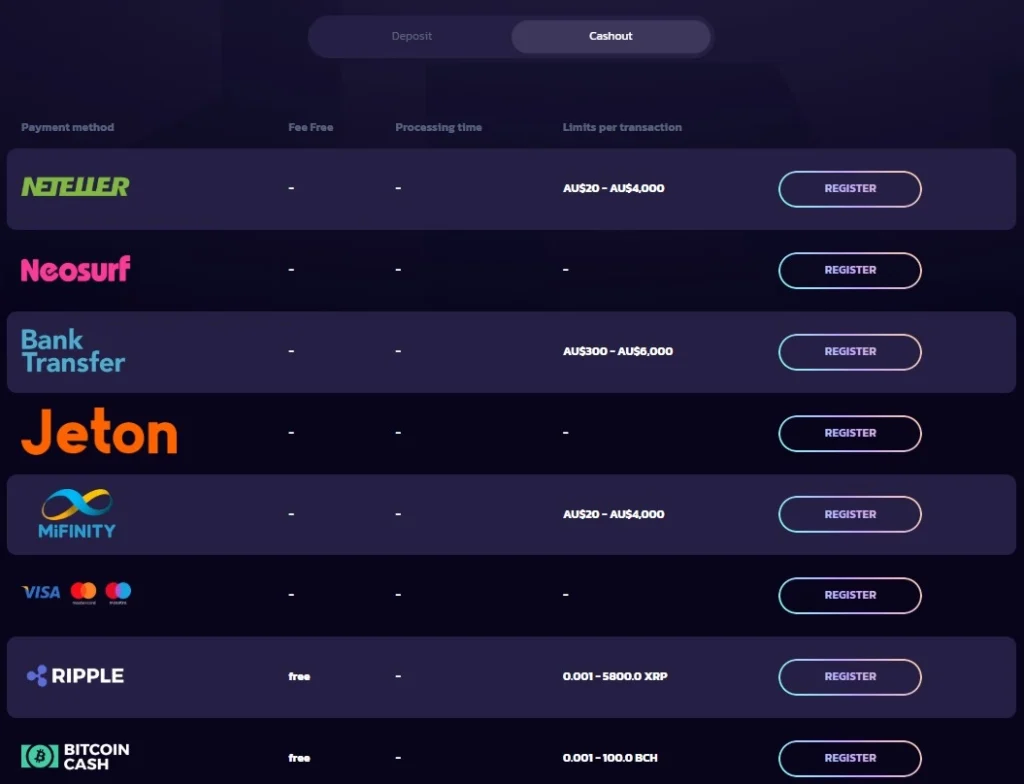
The current AU banking page also shows why that caution matters. Its public deposit table still displays euro-denominated transaction ranges, while one cashout row is explicitly shown in Australian dollars. That mixed display does not cancel AUD support. It means the live cashier is the place to confirm the exact method, currency, minimum, maximum and any fee field before moving money. For cashout-specific limits and timing, use the separate 21bit withdrawals guide.
What payment support is actually verified
The strongest verified baseline is simple: AUD is accepted, and 21bit supports the main payment categories of cards, e-wallets, bank transfers and crypto. These are category-level facts. They tell you that the cashier is not limited to one funding rail, but they do not prove that every card network, wallet brand or bank-transfer product is enabled for every Australian account.
This distinction matters because casino payment pages are often dynamic. Method availability can depend on account status, location, currency, payment provider and whether you are depositing or withdrawing. A method can also appear on the deposit side without being the route eventually used for a cashout. Treat the public banking table as orientation and the authenticated cashier as the final transaction screen.
For a broader view of the operator, games and Australian context, return to the 21bit Australia review. This payments page stays focused on funding and cashier mechanics rather than repeating the full review.
AUD support does not mean every row will be labelled in AUD
21bit lists AUD among its supported currencies. That is the relevant fact for an Australian account. At the same time, the public AU banking page currently contains rows whose visible transaction ranges are presented in euros. On the cashout side, another row is explicitly shown as AU$300 to AU$6,000. The practical lesson is that currency support and a public table’s display currency are two different things.
Do not convert a euro-denominated cashier row into Australian dollars yourself and present the result as an official limit. The site’s own terms use explicit AUD values where they intend to state an AUD rule, and the cashier can show method-specific ranges. When the page displays euros, keep the value in euros or simply describe it as the displayed method range. When the live account cashier shows an AUD value, that is the value relevant to the transaction you are about to make.
This is also why a single public row should not be treated as a universal minimum or maximum. The banking page itself says limits are per transaction, and the general terms say maximum deposit and withdrawal amounts can vary by payment method. A precise decision should therefore be made at the method-selection step, not from a generic casino review table.
Cards, e-wallets and bank transfers
Cards, e-wallets and bank transfers are all verified payment categories at 21bit. They solve different practical needs, but this guide does not invent specific brand support where the current public page does not expose the method name in text. The useful comparison is instead about what you should verify for any method before using it.
| Check | Why it matters |
|---|---|
| Deposit or cashout availability | A method may be available in one direction but not the other. |
| Displayed currency | The AU banking page can show EUR-default rows alongside an AUD cashout row. |
| Per-transaction range | Minimums and maximums can differ by method. |
| Fee field | Use the live cashier value rather than assuming every route is fee-free. |
| Account verification | Cashout can depend on KYC and account checks. |
A bank transfer can be attractive when you want a familiar account-to-account destination, while an e-wallet can separate casino transactions from a main bank card. Those are general payment characteristics, not promises about speed or availability at 21bit. The right question is always whether the route is currently offered to your account and what the cashier says about its limits.
Crypto support: what 21bit currently covers
Crypto is a meaningful part of 21bit’s cashier rather than a separate product. Verified supported cryptocurrencies include BTC, BCH, LTC, DOGE, ETH, USDT, TRX, BNB and XRP. That range covers both major crypto assets and stablecoin-style funding through USDT, but the presence of crypto should not be confused with crypto being the normal payment preference for Australian consumers.
Broader Australian payment patterns point in the opposite direction for everyday purchases: cards remain dominant, mobile-wallet use is growing, PayID is widely recognised, and cryptocurrency payment use is comparatively limited. That market context can help explain what Australians are used to, but it is not evidence that 21bit supports PayID or a particular mobile wallet. Brand support and Australian payment habits must stay separate.
If you choose crypto, confirm the selected asset, network and destination details in the cashier before sending funds. Crypto transfers are difficult to reverse if sent to the wrong address or network. This guide does not provide investment advice, exchange-rate predictions or claims that crypto is faster or cheaper in every case.
Why PayID familiarity is not evidence of PayID support
PayID is a good example of a common review error. It is a widely recognised Australian account-to-account payment method, so it is tempting to assume that an Australia-facing casino will support it. That inference is not valid. Market popularity describes consumer behaviour in Australia; it does not describe 21bit’s current cashier configuration.
The same rule applies to mobile wallets. Australian consumers increasingly use mobile devices for contactless payments, but that does not prove Apple Pay or Google Pay is available as a 21bit deposit method. This page therefore names only the payment categories and cryptocurrencies supported in the verified brand information, while leaving specific locally popular brands to the live cashier check.
This separation is one of the most useful ways to read casino payment guides. If a review says that a payment method is “popular in Australia”, that statement should never be allowed to quietly become “available at this casino” without brand-level evidence.
How to read the 21bit banking table
The public banking page uses the columns payment method, fee, processing time and limits per transaction. In the text-visible version of the current AU page, some method names are represented by images rather than readable labels. That limits how far a responsible review can go: it is possible to verify that multiple rows and transaction ranges exist without pretending to know every logo represented by those images.
For deposits, the public AU page currently shows euro-denominated rows with transaction ranges of €10 to €4,000. For cashout, it shows rows including €10 to €10,000, €20 to €5,000 and an AU$300 to AU$6,000 row. These are current public table values, not universal account limits. The method attached to each image-based row must be confirmed visually in the live page or cashier before you rely on it.
The general terms add a second layer: minimum and maximum amounts can be governed by general rules and then narrowed by the chosen method. This is why the child cashout guide treats withdrawal frequency limits separately from a method’s per-transaction range.
Deposit planning: a practical order of checks
- Confirm that your account is set to AUD if that is the currency you intend to use.
- Open the deposit cashier and check which card, e-wallet, bank-transfer and crypto options are actually shown.
- Read the method’s minimum and maximum before entering an amount.
- Check the fee and processing fields instead of assuming a route is free or immediate.
- If a bonus is involved, open the 21bit bonuses guide and confirm that the deposit meets the current offer conditions.
- Keep the payment source in your own name. The terms prohibit third-party deposits.
The final point is especially important for verification. A payment route that is technically available can still create problems if the account holder and payment-source information do not match. If you have not yet created an account, the 21bit registration and KYC guide explains the account-verification side of the process.
Cashout is a separate decision from depositing
Deposit convenience is not enough to judge a cashier. A useful payment setup also needs a workable withdrawal route, clear limits and a manageable verification process. 21bit’s terms allow withdrawals to be paid through a different method than the one originally selected when necessary, which is another reason not to assume deposit and cashout routes will always mirror each other.
Exact cashout limits, processing targets and KYC document requirements are freshness-sensitive and belong on the dedicated withdrawal page. That page separates three different concepts: a method’s per-transaction range, the account-level daily/weekly/monthly limits in the terms, and the time it can take after the casino approves a request.
Before making a large deposit, read that cashout structure first. It is easier to decide whether a casino’s banking setup suits you before funds are in the account than when you are already trying to withdraw.
Payments, regulation and what this page does not claim
This page stays focused on cashier support, AUD handling and method availability. For operator and Australian regulatory questions, use the trust and licence guide.
Bottom line for Australian users
21bit has a broad cashier foundation: AUD support, card, e-wallet and bank-transfer categories, plus BTC, BCH, LTC, DOGE, ETH, USDT, TRX, BNB and XRP. The weakness of a static payment list is that the public AU banking page mixes display currencies and relies on image-based method labels, so a review cannot responsibly promise every familiar Australian payment brand.
The best workflow is simple. Use this page to understand the verified categories, then use the live cashier to confirm the exact method and transaction row for your account. For deposits, check amount, fee field and bonus interaction. For withdrawals, check the dedicated cashout rules and KYC requirements before funding the account.
FAQ
Does 21bit accept AUD?
Yes. AUD is a verified supported currency. However, some rows on the public AU banking page are still displayed in euros, so confirm the live cashier value for the method you select.
Does 21bit support PayID?
This guide does not claim PayID support because the current evidence used for the site verifies payment categories, not PayID as a specific 21bit method. Check the live cashier rather than inferring support from PayID’s popularity in Australia.
Which cryptocurrencies are supported?
The verified set includes BTC, BCH, LTC, DOGE, ETH, USDT, TRX, BNB and XRP.
Are deposits and withdrawals guaranteed to use the same method?
No such guarantee should be assumed. 21bit’s terms allow the operator to use a different withdrawal method when necessary.
This material was created by the 21bit Australia Guide team.
21bit Payment Methods Australia — More on this topic at 21bit casino.
See also 21bit Registration and KYC Australia.
Related posts
21bit Withdrawals Australia: Limits, Processing and KYC
21bit Pokies Australia: Slots, Categories and Provider Restrictions